Working notes on tokens, credits and the API
What we learn running an AI API platform: how a request is priced, what the meter records, and the parts a rate card cannot tell you.

-
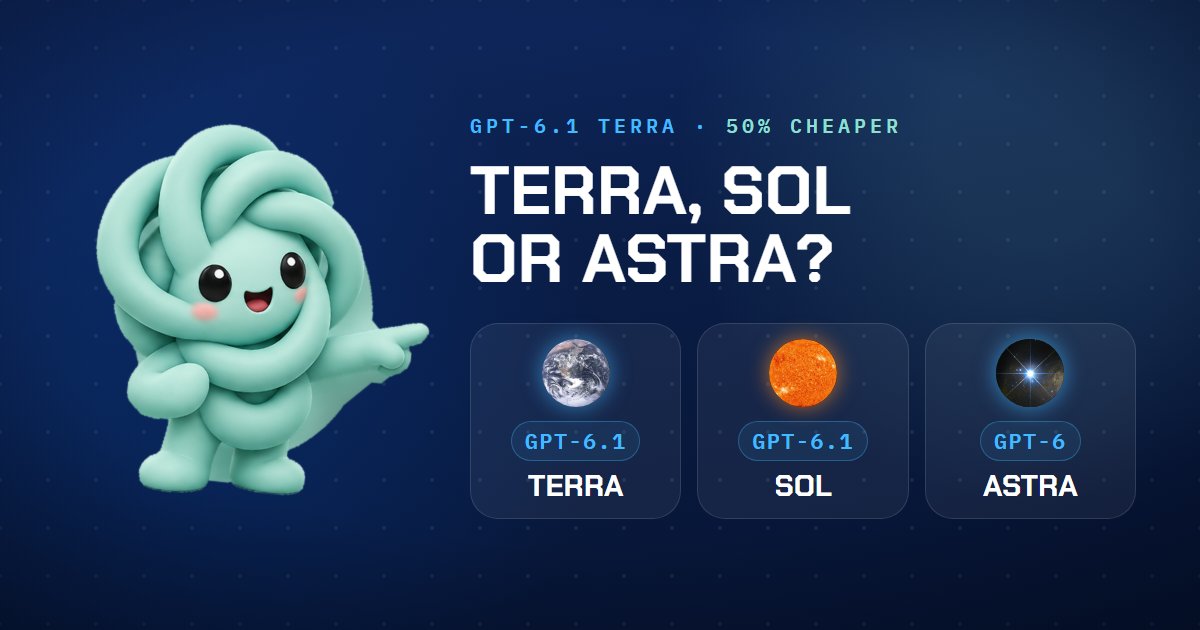
GPT-6.1 Terra is here: which model should you use?
GPT-6.1 Terra costs half what Sol does. What Terra, Sol and Astra each cost, where each wins on OpenAI's own benchmarks, and which one to pick for each task.
-
Choosing between astra, sol, terra and luna
A procedure, not a table: start on terra, move a class of request to sol when reasoning pays, spend astra deliberately, and leave the background to luna.
-
Using Cursor with your own base URL
Cursor speaks the OpenAI API, so it can speak here instead: the two fields to fill in its model settings, the five models, and a command that checks both.
-
LangChain on an OpenAI-compatible API
The two fields ChatOpenAI needs to reach this endpoint, why invoke, stream and tool calls pass through unchanged, and how cache reads keep an agent loop lean.
-
Point the OpenAI SDK at a new base URL
Two changes move an existing OpenAI-SDK app here: the base URL and the key. Chat completions, responses, streaming and tool calling all arrive unchanged.
-
Streaming, and the 100-second edge
Why a long non-streaming request dies at the edge after roughly 100 seconds, how one field prevents it, and what the meter does around a stream.
-
Per-class token pricing, explained
Why input, cache reads, cache writes and output are metered apart, what each model charges per token class, and one real request worked through.