
GPT-6.1 Terra is here: which model should you use?
GPT-6.1 Terra costs half what Sol does. What Terra, Sol and Astra each cost, where each wins on OpenAI's own benchmarks, and which one to pick for each task.
OpenAI has released GPT-6.1 Terra, the small, fast member of its current lineup. That leaves developers with three strong options from the same generation: GPT-6.1 Terra, GPT-6.1 Sol and GPT-6 Astra. They are priced very differently, and they are not good at the same things. This guide walks through what each one is for, so you can pick the right model for each job instead of paying for the biggest one by default.
Every figure below is quoted from OpenAI's three launch posts, which we read on 27 October 2026 and list at the end. We did not run benchmarks of our own, and no number here was read off a chart.
Prefer to watch? The 90-second version is on our TikTok and our Facebook page.
Watch the 90-second video on TikTok.
What GPT-6.1 Terra is
Terra is the everyday model: quick and inexpensive. OpenAI says its prices are "50% lower than those of GPT-5.6 Terra and GPT-6.1 Sol", and the step up from the previous Terra is not small. On Terminal-Bench 4.0, a benchmark of real tasks an AI agent has to complete in a command-line terminal, Terra scores 50.3% at max effort, against 21.5% for GPT-5.6 Terra. ("Effort" is the setting that controls how much the model reasons before it answers.)
It also makes fewer factual mistakes. On prompts designed to induce errors, OpenAI reports that Terra's factual error rate falls from 53.6% to 16.7% at low effort, and to 4.3% at max effort, "nearly matching" Astra and Sol.
GPT-6.1 Terra pricing vs Sol and Astra
All prices are per 1 million tokens, as listed in OpenAI's launch posts. "Cached input" is the lower price for input the model has recently seen, such as a long system prompt you send with every request.
- GPT-6.1 Terra: $1 input, $0.05 cached input, $5 output.
- GPT-6.1 Sol: $2 input, $0.10 cached input, $10 output.
- GPT-6 Astra: $10 input, $1 cached input, $50 output.
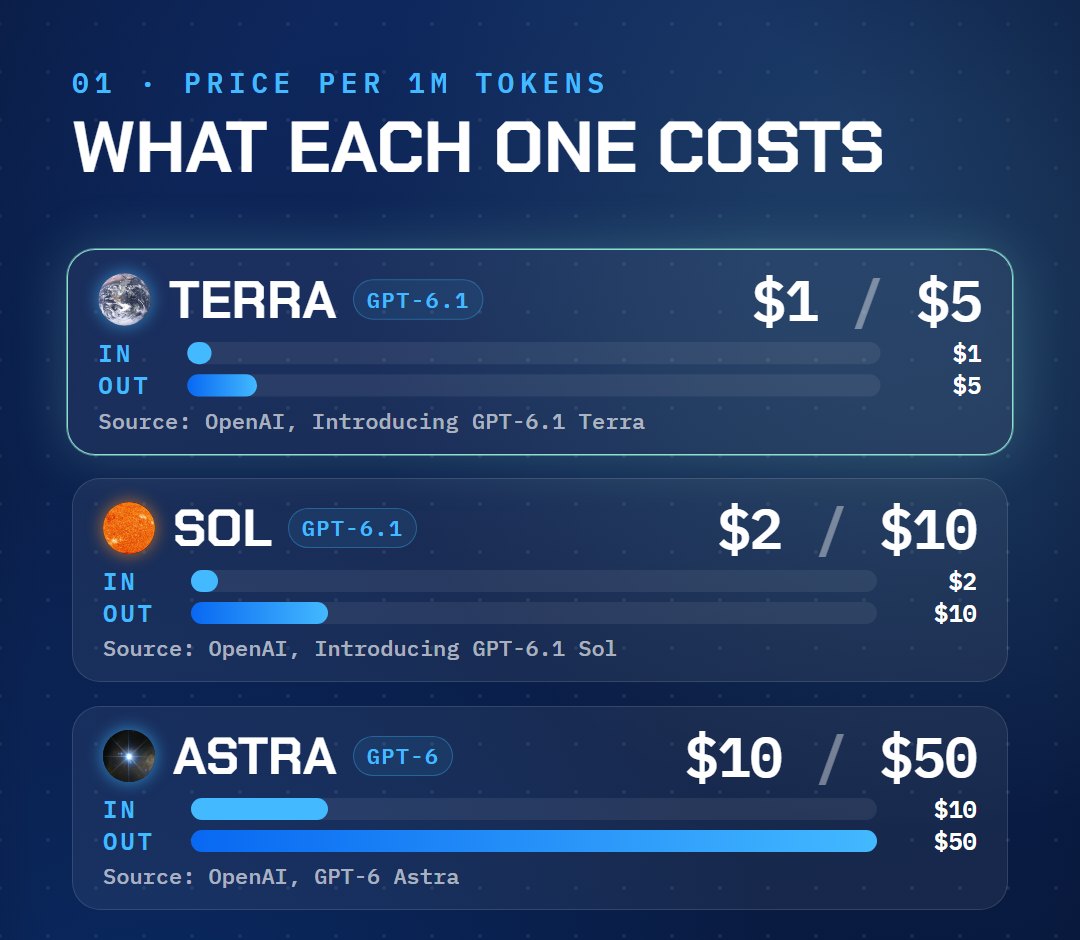
Astra's standard input and output prices are five times Sol's and ten times Terra's. To make that concrete with our own arithmetic from the prices above: a request with 10,000 input tokens and 1,000 output tokens, none of them cached, costs $0.015 on Terra, $0.03 on Sol and $0.15 on Astra. That gap, repeated over every request you send, is the whole reason the choice matters.
Where Terra shines
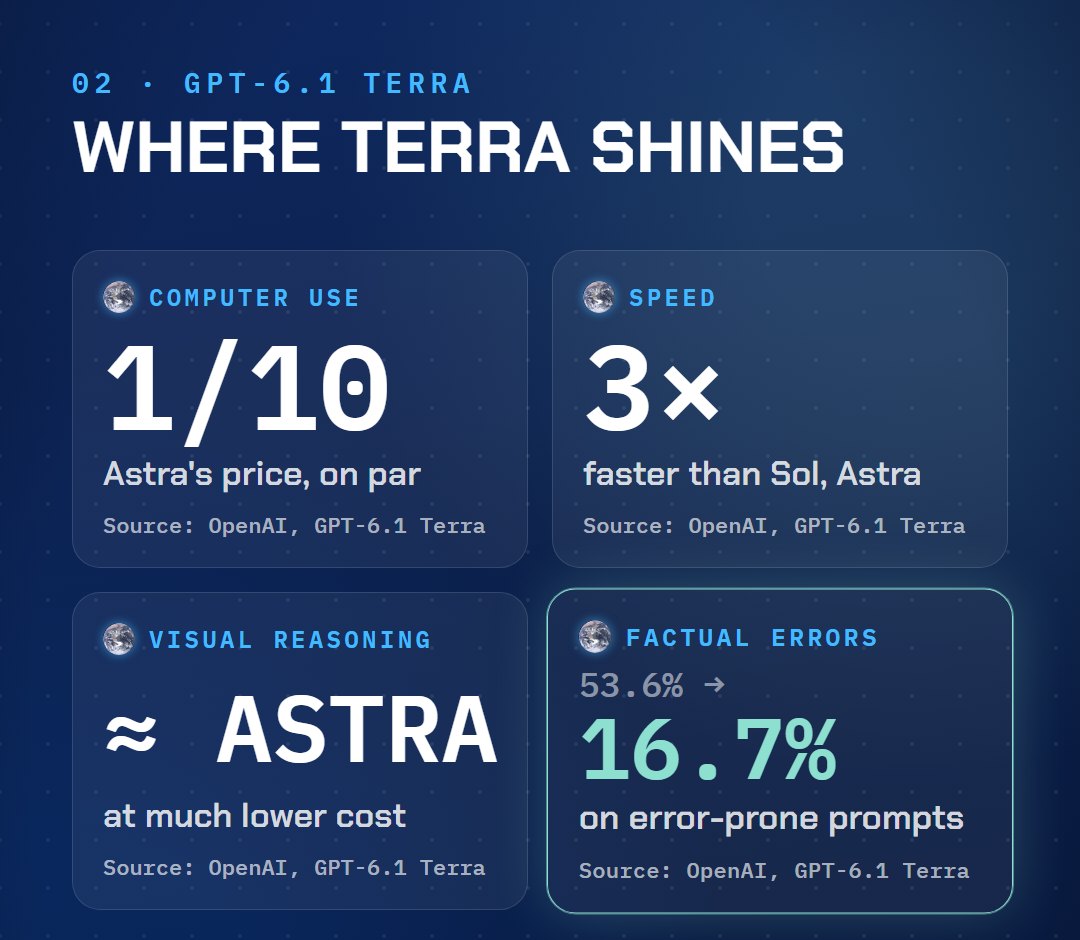
Operating a computer. Agents' Last Exam measures how well a model uses a computer on its own to finish tasks. At medium effort, Terra scores 15 percentage points higher than GPT-5.6 Terra at about one-third the cost, and OpenAI puts it "on par with GPT-6 Astra at only one-tenth its price per token".
Speed. OpenAI describes Terra as "completing tasks over three times faster than both GPT-6 Astra and GPT-6.1 Sol". For anything a person waits on, such as chat, autocomplete and quick agents, that matters as much as quality.
Understanding images. MMMU-Pro tests reasoning over pictures, charts and diagrams across many subjects. Terra "nearly matches" Astra and Sol there "at much lower cost".
Some science work, too. On Terminal-Bench-Science 0.1, which tests scientific tasks carried out in a terminal, OpenAI says Terra "surpasses GPT-6.1 Sol at lower cost".
OpenAI is also clear about Terra's limit: "For the most complex coding tasks, GPT-6.1 Sol and GPT-6 Astra remain the better choice."
When to pick GPT-6.1 Sol
Sol is the model for serious code. OpenAI's launch post says it "nearly matches GPT-6 Astra's intelligence on agentic coding, computer use, and professional work at one-fifth of Astra's standard input and output token prices".
The benchmarks behind that claim:
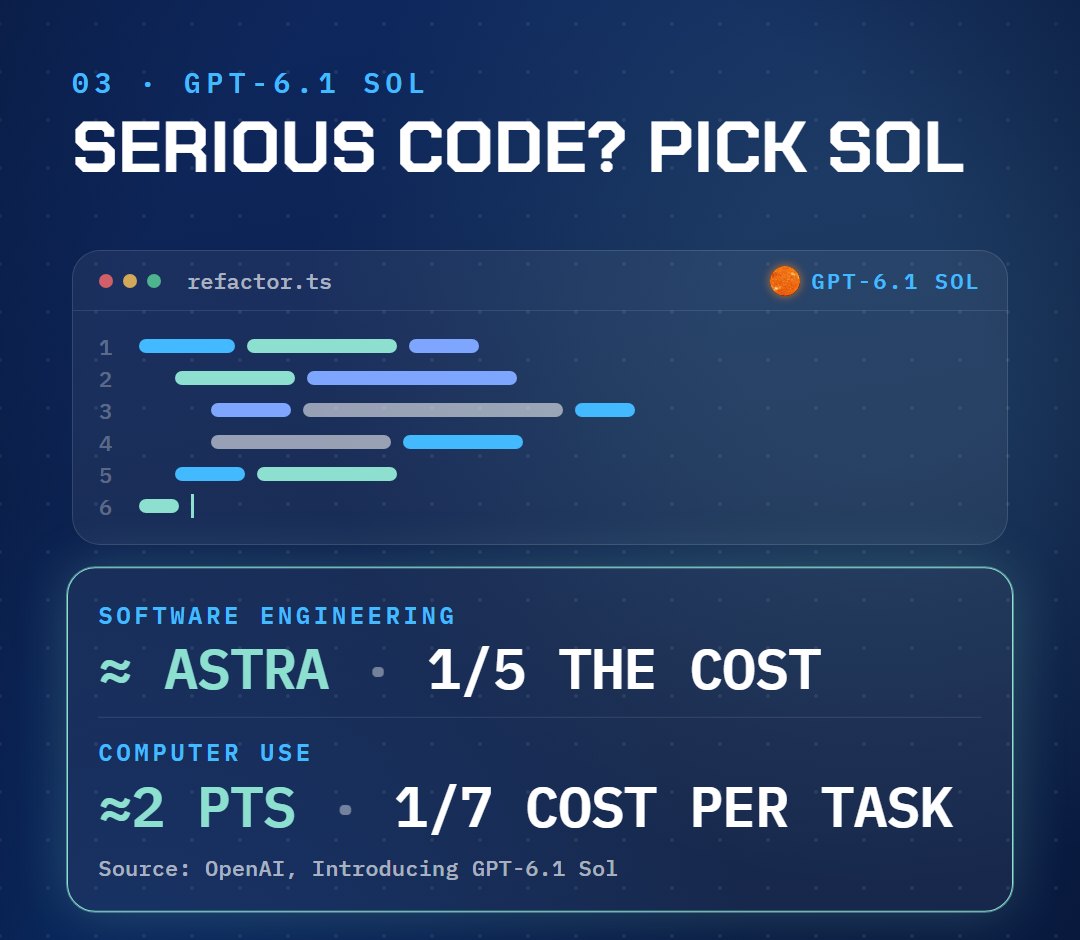
- DeepSWE v1.1, an agentic coding benchmark: Sol "matches GPT-6 Astra at roughly one-fifth of the cost".
- OSWorld 2.0, which tests completing real tasks on a desktop operating system: Sol is "within 2.1 percentage points of Astra's score", at roughly one-seventh the cost per task.
- Terminal-Bench Science: Sol costs $5.47 per task, against $23.80 for Astra.
If you live in a code editor or run coding agents all day, OpenAI also says an Ultrafast variant of Sol is coming, with "up to 8x faster token generation" in Codex.
Choose Sol when a task is hard enough that Terra's answers are not good enough, but you still pay for every token: large refactors, multi-file changes, debugging agents and professional writing that has to be right.
When to pick GPT-6 Astra
Astra is the top of the range. OpenAI calls it "the world's most intelligent and aligned model" and "the best model for software engineering to date". It is state of the art on computer use, with 72.6% on OSWorld 2.0.
It is also the strongest on scientific work: the Sol post lists Astra highest on Terminal-Bench Science, at 68.1%, and OpenAI says Astra "should be used for the most difficult scientific research tasks".
Astra is the most expensive of the three by a wide margin, so it earns its place on the problems where the other two fall short: research questions, the hardest engineering problems, and work where one wrong answer costs more than the tokens.
GPT-6.1 Terra vs Sol vs Astra: which to use for each task
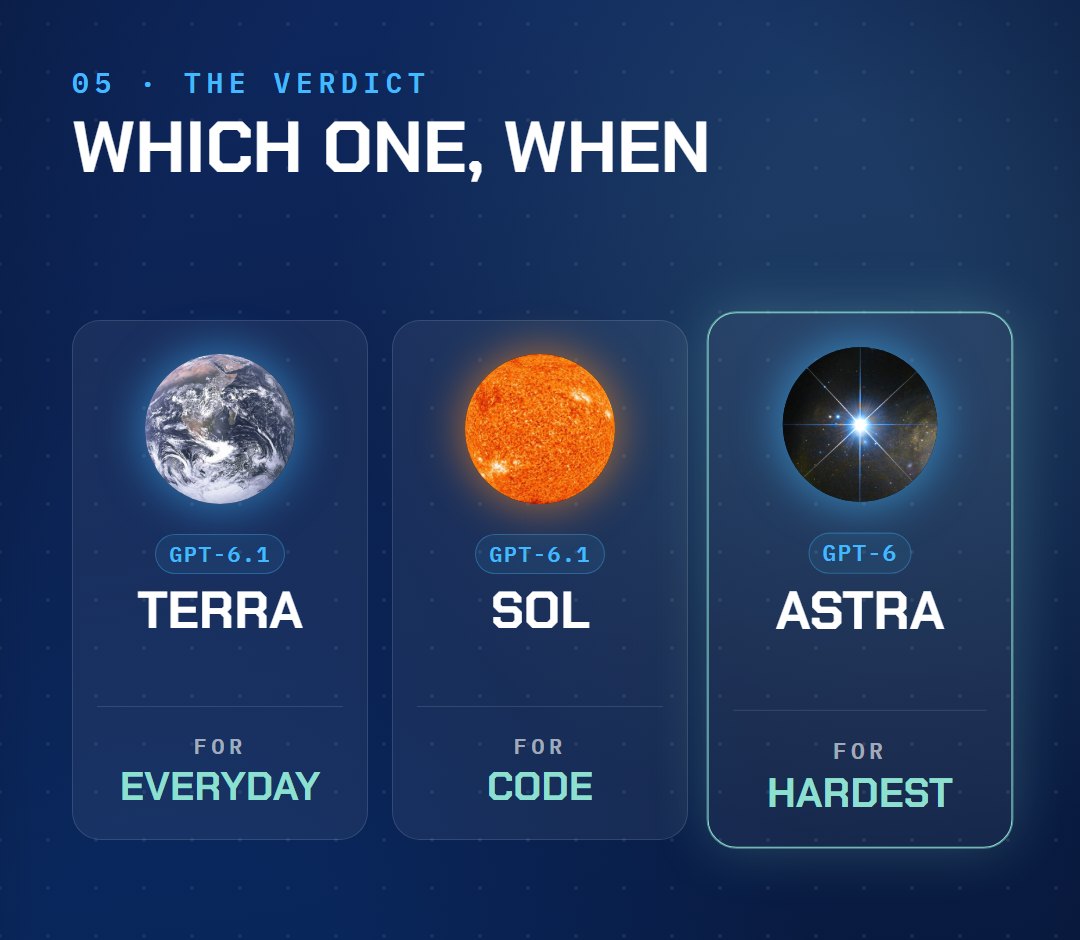
Start with GPT-6.1 Terra for
- Chat, summaries and everyday questions: the lowest price, and over three times faster than Sol and Astra.
- Agents that operate a computer: on par with Astra on Agents' Last Exam at one-tenth the price per token.
- Reading images, charts and screenshots: nearly matches Astra and Sol on MMMU-Pro at much lower cost.
- Everyday coding and terminal tasks: a big step up from GPT-5.6 Terra on Terminal-Bench 4.0.
Move to GPT-6.1 Sol for
- Serious coding, such as refactors, multi-file changes and coding agents: matches Astra on DeepSWE v1.1 at roughly one-fifth the cost.
- Professional work that must be right: nearly matches Astra at one-fifth of its token prices.
Save GPT-6 Astra for
- The hardest engineering problems: OpenAI's best model for software engineering to date.
- Difficult scientific research: the highest score on Terminal-Bench Science.
A practical way to use this list: start on Terra, and move a task up to Sol or Astra only when you can see the cheaper model's answers are not good enough. Our longer guide to choosing between astra, sol, terra and luna turns that habit into a procedure you can apply to each kind of request.
The one-line verdict
Terra for everyday. Sol for serious code. Astra for the hardest problems.
Use all three with one key, from $30 a month
You do not need three accounts to use Terra, Sol and Astra. AI From U puts terra, sol-6.1 and astra (and luna, for the cheapest jobs) behind one OpenAI-compatible API key, at a fixed price per 30 days with no overage billing. Four plans, as our pricing page lists them today:
- Starter, $30 per 30 days: 185,000,000 credits, about $0.16 per million credits.
- Growth, $40 per 30 days: 365,000,000 credits, about $0.11 per million.
- Pro, $50 per 30 days: 735,000,000 credits, about $0.07 per million.
- Scale, $60 per 30 days: 1,100,000,000 credits, about $0.055 per million, the lowest rate of the four.
These are launch prices, already 23 to 25 percent under the list price, and they hold for as long as the launch window is open. Every plan works the same way: your credits reset every 30 days, a request converts its tokens to credits at the rate of the model it names, a cached input token costs half that model's input rate, and when the credits reach zero new requests simply stop, so your card is never charged for overage.
Pick a plan on the AI From U plans and what each one includes page, point your existing OpenAI client at our API as our API documentation shows, and switch the model name per task as the list above suggests: terra for everyday, sol-6.1 for serious code, astra for the hardest problems. The role of each model we offer is set out on our models page. AI From U is an independent service, not affiliated with OpenAI.
For short breakdowns of each new model as it lands, follow AI From U on TikTok and Facebook.
Sources
- OpenAI, Introducing GPT-6.1 Terra (launch post, read 27 October 2026): Terra's prices, Terminal-Bench 4.0, factual error rates, Agents' Last Exam, speed, MMMU-Pro and Terminal-Bench-Science 0.1.
- OpenAI, Introducing GPT-6.1 Sol (launch post, read 27 October 2026): Sol's prices, DeepSWE v1.1, OSWorld 2.0, the Terminal-Bench Science costs and scores, and the Ultrafast variant.
- OpenAI, GPT-6 Astra: A new generation of intelligence (launch post, read 27 October 2026): Astra's prices, how OpenAI describes it, and its OSWorld 2.0 score.